
Imagine a busy Tuesday morning at a local dental clinic or a car repair workshop. The waiting room is quiet, but not because there are no appointments. Several clients have simply forgotten their slots. The receptionist spends the next hour dialing numbers, leaving voicemails that will never be returned, and trying to fill empty slots at the last minute. This manual coordination is a massive drain on operational efficiency. Many businesses look to automate this by setting up an automated system, searching for a reliable sms portal that can send simple reminders without introducing complex technical hurdles or unpredictable monthly bills.
Unfortunately, the journey to automate client communication often leads straight into a wall of enterprise bureaucracy. When you sign up for a traditional cloud-based messaging system, you are immediately asked to submit dozens of pages of business registrations, wait weeks for carrier approval, and rent a virtual phone number that your customers do not recognize. For a local clinic, an independent gym, or a neighborhood school, this overhead makes no sense. You do not need global enterprise routing; you just need a straightforward way to send a text message from the number your clients already have saved in their phones.
Why Your Own SIM Card is the Ultimate SMS Portal
The solution to this administrative roadblock lies in the hardware you already carry in your pocket. Instead of renting virtual infrastructure from global aggregators, you can turn an Android phone into a dedicated communication gateway. By installing a lightweight application on an Android device and pairing it with a web dashboard, you establish a direct connection between your business software and the cellular network.
When you send a message through this setup, it does not travel through expensive, third-party carrier routing networks. Instead, the message leaves your own phone, utilizing your own SIM card and your own cellular plan. This approach offers several distinct advantages for local service providers:
- Familiarity: Customers receive messages from your actual business phone number. When they see a text from a number they recognize, they are far more likely to read and reply to it.
- Simplicity: There is no need to navigate complex registration processes, submit national business registry documents, or wait weeks for carrier approval. Your SIM card is already active and authorized on the network.
- Dual-SIM Support: If your business operates multiple branches or distinct service lines, you can use a dual-SIM Android device. Each SIM slot acts as its own independent number, allowing you to route messages through the correct local number automatically.
- Local Routing: Because the messages are sent directly from a local physical device, they follow the exact same path as a manual text message sent by a human.
The Hidden Trap of Segment-Based Metering
One of the most frustrating aspects of traditional cloud gateways is the unpredictable nature of their billing. Most global messaging platforms charge you based on the number of individual segments sent, rather than the number of complete messages. Under the standard GSM-7 character encoding system, a single text message is limited to 160 characters. If your message exceeds this limit by even a single character, it is split into multiple segments, and you are billed for each segment individually.
The problem becomes even more acute when you introduce non-standard characters. If your message contains a single special character—such as a Turkish ı, a Polish ą, or an accented French é—the entire message encoding automatically switches to Unicode. Under Unicode, the character limit per segment drops from 160 to just 70 characters. A simple appointment reminder that looks like a single message to you can easily be split into three or four segments behind the scenes.
When you use a physical Android phone as your gateway, this billing complexity disappears. While the cellular network still technically splits long messages into standard segments for transmission, your relationship with the carrier is governed by your standard mobile plan. This means you can send comprehensive updates, detailed instructions, and personalized reminders without worrying about a single special character doubling or tripling your operational costs. To understand how this structural difference affects your bottom line, you can read more about how a long SMS is billed as a single send rather than per individual segment.
Comparing SIM-Backed Gateways with Cloud Providers
To make an informed decision for your business, it is helpful to look at how a hardware-backed system compares directly with traditional cloud aggregators. Each approach has distinct operational models that impact your setup time, deliverability, and overall cost structure.
Let us look at the key operational differences in the following table:
| Feature or Operational Aspect | Traditional Cloud Aggregators | SIM-Backed Android Gateway |
|---|---|---|
| Sender Number | Rented virtual numbers, shortcodes, or random pools | Your own physical SIM card and recognized number |
| Setup Time | Weeks of registration, vetting, and verification | Minutes (install app, scan QR code, pair) |
| International Pricing | Rates vary drastically by destination country | Governed by your local SIM card plan |
| Message Length Impact | Every 160-character segment is billed separately | No segment-based metering from the gateway provider |
| Inbound Messages | Often requires renting dedicated inbound numbers | Received directly on your phone and forwarded to webhooks |
As the table demonstrates, the primary difference lies in control and simplicity. Traditional providers require you to adapt to their complex routing rules and variable pricing models. A SIM-backed gateway allows you to leverage the mobile infrastructure you already pay for, keeping your communication direct and predictable. You can dive deeper into these fundamental differences in our guide on why destination-based pricing changes are eliminated when you route messages through your own local SIM card.
Seamless Integration with Your Existing Business Software
A great communication tool must fit into the software environment you already use. Whether you run a custom database, use a popular no-code automation platform, or have an in-house developer, connecting to your SIM-backed gateway should be straightforward.
The system provides a clean, modern REST API that allows you to trigger messages with a simple outbound request. The core of the system is a single, highly optimized endpoint: POST /api/v1/send. Authenticated via a standard Bearer token, this endpoint allows you to pass the recipient's phone number and the message content in a clean JSON payload.
For businesses that already have an existing software integration built around other providers, transitioning is incredibly simple. The platform offers a Twilio-compatible endpoint. This means you do not need to rewrite your application's core logic; you can simply update your base URL to point to MySMSGate and keep your existing integration running smoothly. To see how this works in practice, you can read our direct comparison with Twilio and explore how to point your existing code to our endpoint.
If your development team wants to explore the full capabilities of the API, they can consult our comprehensive REST API reference. Additionally, if you rely on modern automation platforms to sync your CRM, booking calendar, or database with your text messaging system, you can explore our pre-built integration guides for Python, JavaScript, PHP, Go, Ruby, Zapier, Make, and n8n.
Two-Way Communication and Outbound Webhooks
Effective client communication is rarely a one-way street. When a client receives an appointment reminder, they often want to reply to confirm, ask a quick question, or request a reschedule. If your automated system cannot handle incoming replies, you miss crucial client feedback and create friction in the customer experience.
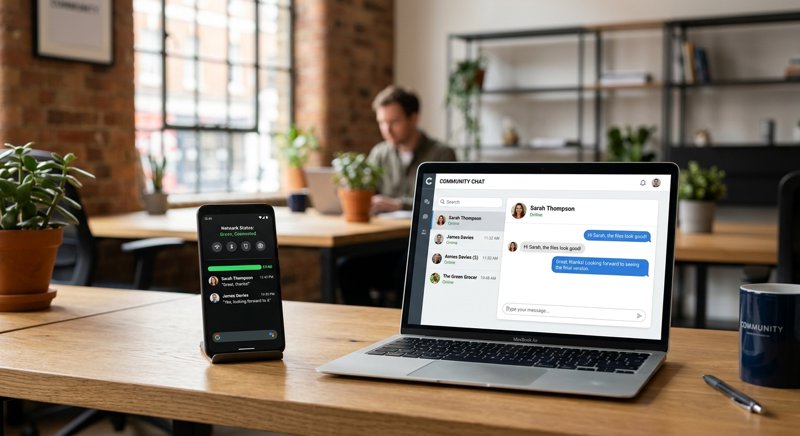
With an Android-based gateway, handling these replies is completely automated. When an inbound SMS arrives on your paired Android device, the application immediately detects it and forwards the content to your web dashboard. From there, you can view the message in a clean, chat-style conversation view, allowing your staff to reply manually from any browser without needing to touch the physical phone.
For businesses that want to automate their responses or log client feedback directly in their CRM, the system supports outbound webhooks. You can configure webhooks for two major events: inbound messages, which trigger an immediate payload to your server whenever a client replies to your number, and outbound status updates, which receive updates when a message successfully transitions through its lifecycle on the device, helping you keep your internal records accurate. This two-way capability ensures that your automated reminders can easily transition into real, human conversations whenever a customer needs assistance, all while keeping your records perfectly synchronized.
How to Get Started with Your Own SMS Portal
Setting up your hardware-backed messaging gateway takes only a few minutes. You do not need to wait for regulatory approvals or navigate complex telecom compliance dashboards. Here is the exact path to getting your system live:
- Prepare Your Android Device: Locate an Android phone that you can keep powered on and connected to the internet. This can be an older device you have lying around or a dedicated budget phone.
- Create Your Account: Head over to our platform to create an account and access your web dashboard.
- Install the App: Download and install the MySMSGate companion application on your Android device.
- Pair the Device: Open the app on your phone and scan the unique QR code displayed on your web dashboard. This instantly pairs your phone with your API key.
- Send a Test Message: Use the simple API runner in your browser dashboard or trigger a quick test request to verify that the message leaves your phone instantly.
By taking control of your own messaging infrastructure, you eliminate the unpredictable costs and administrative friction of traditional providers. You can build a reliable, highly responsive notification system using the phone number your clients already trust, ensuring your local business stays connected with minimal effort.


Comments (0)
Be the first to comment!